

Can I Sell My Ovaries For Money
Chiliad y eyes palpitate open. I'm surrounded by four nurses property me upside down. They milkshake me back and along, urging the blood back to my head. As I regain consciousness I wonder: is this worth it? That "it" is the $10,000 question.
7 months ago, I received my acceptance to Columbia University's School of Journalism. I was absolutely stunned to exist admitted, but even more shocked by the $116,000 toll tag, for tuition and living expenses. The schoolhouse, whose education is widely considered the golden standard in journalism, would provide me with unparalleled access, in an industry I currently felt immobile in.
Fortunately, the vast majority of the cost would be covered by scholarships. For the remaining hire and living costs, I looked for something else to plug the gap. I landed on a burgeoning manufacture offer struggling people vast amounts of cash, relatively fast: egg donation.
I t's ninety-something degrees on a June forenoon in New York City. My wrinkled, green satin skirt sticks to my legs as I blitz into the egg donation clinic's main office for another screening, a urine test.
Over the final four months I've been lying to my somewhat conservative family well-nigh where I've been escaping to on these early on mornings: surreptitiously showing upward for examinations and psychological assessments in lodge to donate my eggs.
Exterior of my family, I'll more often say I'm "selling my eggs". Donation is a term that is supposed to reflect that information technology's a adult female's time, non the value of her eggs, that's being paid for. Merely here was an manufacture offer me more per hour than I'd always earned at a regular job. To say I'm selling feels more honest.
In the clinic's main part, Amy Winehouse's deep voice plays softly on a nearby speaker. Looking around the waiting room, with its lavander and gray accents splashing the walls, I apace realize I'chiliad the but woman sitting alone. I share fleeting glances with giggling couples and wonder if any of them are sizing me up equally a possible donor.
Sometime later my arrival, a nurse calls my name. Amy Winehouse's harmonies fade away. She takes me to a chair in a hallway: a dozen or and then vials clinking effectually on an attached tray. The infinite feels common cold and sterile. The silence is oppressive. I try to recall if I ate breakfast – I didn't.
A nurse scoots over and pulls my arm over the cuff of the chair.
"Cute veins," she says.
Afterward she has filled 8 or so vials with my claret, I slump over and pass out. When I awake, the nurses accept swept me into the air. Semi-conscious, and embarrassed I stumble over an apology.
I'm escorted to a gynecological chair in a nearby test room and given a pineapple flavored lollipop. I lean my caput back against the common cold chair. Some other nurse walks in, showing off more vials in her hand. I curlicue up my sleeve and concord out my other arm. Time for circular two.
I first called the egg donation clinic back in March 2021 – moments before I attended Columbia Journalism School'southward introduction day. The outset time I heard of donation was through a friend during my undergraduate studies. I knew I couldn't risk the distraction and stress of a task while studying at Columbia full-fourth dimension. Plus, the schoolhouse'due south administration reminded us outright that nosotros were to avoid employment during our studies.
The Google search that led me to my new career choice was simple: "Egg donation agencies in New York City." I'1000 not the only one to type it. Every year, donors are being paid in the thousands to provide eggs to prospective parents. The CDC found that in under a decade, IVF cycles using donor eggs nearly tripled, from roughly 5,000 in 2007 to more than 13,000 in 2016.
The woman on the phone was cheery but meticulous when she described the process. In contrast, my first visit to the clinic's SoHo part was impersonal. During my ultrasound, awe-struck as I gazed into the contents of my ovaries and uterus, my doctor spoke about me to the nurse, but not to me.
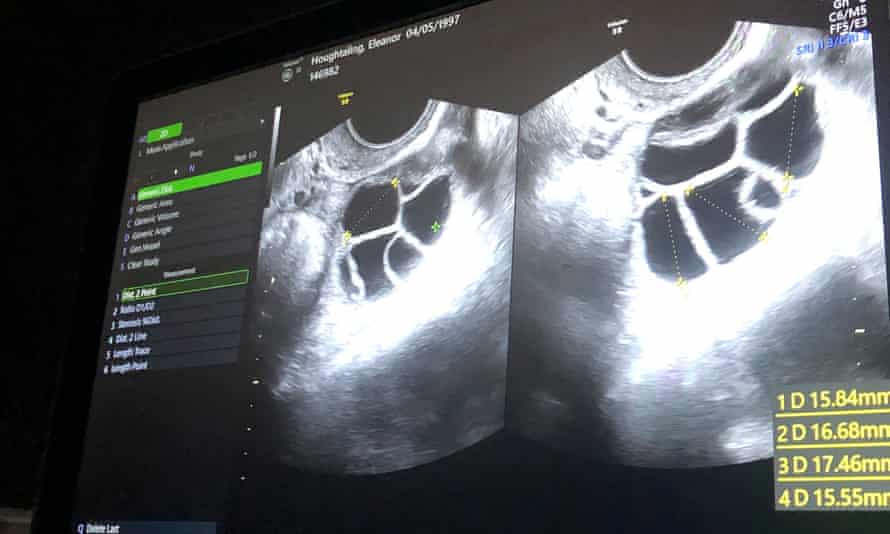
In a traditional medico-patient relationship, the physician'southward bedside manner is central. In the US – where healthcare is privatized and people weigh up doctors as if their health were a business transaction – medical offices care for you well because they want you to come up back. My first mean solar day in SoHo fabricated me realize that this time, I wasn't the patient. I was the product.
The bloodwork from that first date was sent off to a genetic testing facility, Sema4, which tested 283 of my genes against hundreds of disorders. Those ranged from cystic fibrosis and Fragile Ten syndrome – which has been continued to autism – to maple syrup urine disease, a disorder where the body cannot procedure sure amino acids.
I tested positive every bit a carrier for 3 genetic weather: dystrophic epidermolysis bullosa – a condition that creates skin so frail that it blisters and breaks hands, leaving severe scarring; metachromatic leukodystrophy – a rare genetic disorder; and non-syndromic hearing loss. I felt a mixture of stupor and morbid marvel hearing the results, though the dispensary reassured me it was normal to examination positive for a small-scale handful of genetic disorders.
Epidermolysis bullosa has no cure, and people built-in with the condition are at increased risk for an extremely aggressive form of skin cancer. The Sema4 representative playfully told me not to autumn in love with Finnish people, who are more than likely to have the same skin status.
The telephone call offered a window into a different world: where everybody is a carrier of disease, myself included. I was forced to confront a reality where I might pass on complex disorders to my children, ones I never thought I had.
The dispensary was not just assessing my predisposition for genetic disorders, information technology was too weighing up other attributes: my blonde hair, my blue eyes and my fair skin. Over screening calls, squad members would subtly compliment and affirm descriptions of my body, personality and ivy league pedagogy. Altogether, I had concerns this was sanitized eugenics. But through what other language did I await them to build a relationship with me? They were paying me $10,000 for my eggs. The very nature of our business revolved around my body.
I n May, early on in the procedure, the clinic set me up to speak with their psychologist. Lounging in the hammock on my balcony, I was exposed to the philosophy of the clinic. My eggs weren't "mine" and "my eggs" were certainly non synonymous with "my child". Rather, they saw my eggs equally a office of a larger genetic pool, i that spanned generations and geographic locations.
I was concerned the psychologist was assessing my mental health, looking to disqualify me from the procedure, but as our conversation flowed I realized she was actually trying to ascertain whether I was intelligent enough to brand the decision to give abroad my eggs. She gave me an IQ test. Information technology was New York country regulation.
The thought that my eggs weren't "mine" but rather some genetic necktie to the by struck me as odd and uncomfortable at start, but over fourth dimension I grew to adopt that framing to my own. I wasn't giving up "my" kid – I was giving up another menses. This would help struggling parents excogitate children of their ain. There was something wholesome about that.
The idea that a small-scale kid, that looked similar me would roam the world while I experienced my early twenties never fazed me. The thought actually warmed my middle.
I grew to realize I wanted children of my ain one 24-hour interval, and part of me yearned for the experience I was offering to someone else. I imagined the mom who would take my eggs.
Was she funny? What kind of school lunches would she pack? Was she compassionate and patient? Would she agree the child's mitt often? Did her moral values reflect my own? I would never know. My donation was anonymous finish-to-end.
B y summertime, the clinic had taken me off of my birth control and put me on their own. One morning when I went to their office to collect an envelope of the beige pills, the nurse handing them to me apologized, saying she didn't understand why it was taking so long to match me with a family.
"You're a hot article," she said.
We paused for a moment, staring at one another. My hair had fallen in front of my eyes. I pushed the muddy blonde strands back backside my ear before erupting in uncomfortable laughter. We both knew what she meant.
A few days away from my egg retrieval engagement I was sitting on the edge of my bed feeling truly unsettled. It was belatedly, and in the tranquility I felt the at-home ripped away from me every bit I laid out one of the last packs of medication, a 250 microgram syringe of Ganirelix, on my table stand.
It took some mental gymnastics to acquire to inject myself with hormones twice daily. Each medication had a different ritual. In the morning, a yellow and blueish plastic pen would deliver 225 ml of Follistim, clicking every bit I pushed the pen down to dispense the refrigerated serum. In the evenings, I would mix a vial of Menopur. Combined, these two drugs worked to stimulate the follicles in my ovaries, aiming to release anywhere betwixt 10-20 eggs – ordinarily, simply one egg is released during ovulation.
Days earlier retrieval, Ganirelix would prevent me from ovulating, giving the eggs a chance to mature and and so exist nerveless before being released from my ovaries.
This final phase numbed me. The rigamarole of daily injections and 7 am ultrasounds had worn me down, and I was tired. On the horizon, I nonetheless had i more hurdle: retrieval. I ran my manus over my stomach, feeling the tender needle sites and the bloat underneath, non wanting to undergo the surgery but also knowing it was too tardily to turn back. I grabbed my starting time syringe of Ganirelix and took a deep breath.
I surveyed a dozen women of varying ages and backgrounds on their personal experiences donating. Dissimilar infertility forums for people going through IVF or surrogacy, there was no clear online location where donors could back up each other through the process of egg donation. Instead, I found them scattered across private Facebook groups, WhatsApp chats and Reddit.
Well-nigh donated during their early on twenties and all participated for the fiscal compensation, at least originally. There was a pay scale, largely determined past geographic location and time of donation, ranging from $3,000 to $20,000. Women used the money to pay for bills, student loans or vacations.
Some donors matched with intended parents or agencies through advertisements placed on Facebook or Instagram. Others found their matches on Craigslist, responding to blanket ads not dissimilarly phrased to those looking to sell a bike, flat or automobile.
"JEWISH WOMEN --- Earn $10,000 with the Souvenir of Egg Donation"
"Chinese, Vietnam, Korean, Asian Egg Donors Earn $ten,000"
"Seeking a Highly Intelligent Egg Donor! Compensation up to $40K"
Since these listings are sometimes posted directly by the intended parents, they may accept shorter or less thorough initial awarding processes, and they can offer significantly higher budgetary sums than agencies or clinics traditionally would. But applying to unverified listings poses obvious risks. In 2011, an Idaho woman was charged with fraud for stealing eggs from donors through Craigslist, never paying the agreed upon sums afterwards receiving the eggs.
Attempting, in role, to brand the process safer, organizations began pairing donors and intended parents through their ain vetted databases. Prospective parents, can now scroll through the profiles of thousands of potential donors, not different on a dating website. Circumvolve Surrogacy offers non-anonymous pairings, where the donor has an opportunity to run into and collaborate with the families.
Jordan Whaley Finnerty'south contour features an paradigm of her and so five-yr-onetime girl – all smiles beside her mom. Whaley set it up when she was 27.
That was in 2018, later on a wine night with a friend who had just undergone a donation herself – Finnerty was intrigued, particularly by the $ix,000 lump sum. She wasn't desperate for the money, but she knew it would help her stop living paycheck to paycheck. She applied that dark and forgot well-nigh it.
"Four months later I was donating," Finnerty said.
Since then, Finnerty has donated four times.
"It wasn't until I was matched with a family, met them, [and] spoke with them that I realized the touch," said Finnerty. "You don't realize the lengths couples have to become through to have children." She's had contact with all of the families she's donated to. Beingness exposed to the parents' gratitude changed her heed. Now, the goodwill of element, not the money, is her favorite part: She plans to donate six times – the maximum advisable.
Still, she acknowledges certain problems in the industry.
"Speaking with intended parents, they express how weird it is to be going over girls' profiles and looking into their health history, basing their preferences off of hair color or center color," Finnerty told me over Facebook i evening.
But she likewise knows that people brand these choices with their partners all the time.
To prevent people from altruistic repeatedly (with the risks being unknown), or incentivizing people to withhold data to make themselves more than bonny to donors, ethical guidelines propose offering less money.
In a recent opinion published by American Society for Reproductive Medicine – which dissuades agencies from compensating donors more than $10,000 – the society found that 88% of donors compensated up to $5,000 for their eggs answered in a self-report questionnaire that "being able to help someone" was their biggest motivation.
"I think [people assume] at that place's a sense of coercion out there, but there's really none of that," said Deborah Mecerod who runs MyEggBank, the largest egg donation bank network in the United states of america. Their policy is to offer one flat-fee as payment, capped at $x,000. Mecerod feels the experience is very rewarding for prospective donors, through the education and free genetic testing, even if they choose not to follow through with the donation. "At that place's ever the option to leave the process," she said.
While many women admit to existence pulled in by the amount they tin earn from their eggs, near I spoke to even so saw it every bit a choice.
"The first and second time I was unemployed or barely employed, so in a mode [I needed the money] but I wasn't drastic for information technology," explains Dolan Wells Gallagher, who has now donated her eggs three times. The first and 2nd time she used the money to cover rent while she was between jobs, the third time, to pay tuition fees.
Data and long-term research on egg donation is scarce. In 2016, new research suggested that fertility drugs may be linked to the development of uterine cancers. A 2017 written report by The Donor Sibling Registry found suspicious occurrences of chest cancer in otherwise healthy immature donors who showed no genetic predisposition to the disease, citing hormone therapy during donation as a possible cause. "The lack of information may be misleadingly interpreted every bit lack of risk," the report warned.
Four years later, there's nonetheless no semblance of a long-term database to monitor the health of donors. Furthermore, while health data is monitored for those who donate organs, the same information is non required for egg donation: it is up to donation agencies to request past medical information on donors, and even then they are at the mercy of donors voluntarily doing so – and telling the truth when they do. Well-nigh are not asked for, and do not report, medical changes afterward starting the process.
In the meantime, thousands of young donors every year undergo egg removal and hormone treatment, without anyone fully agreement the consequences.
"Having a donor registry would be such a great tool for and then many different reasons, because you lot could collect data from the donor, how she's doing and follow up in years to come," explains Mecerod, who believes legislation and federal regime intervention would help solve this problem.
Merely nigh women I interviewed didn't seem too bogged down past the ramifications of long-term health complications. Most of them needed the money. When the bicycle ends, the donors leave with the future impacts a mystery.
U p until the very end of my first donation, I felt positive about my experience. Despite fainting; feeling objectified and shuffled around; despite the laborious injections, I nonetheless liked it. I felt comfort and satisfaction knowing I helped people achieve their dreams.
But in the final days ticking downwards to my surgery, I felt a slew of emotions that dislocated what I thought would be a rewarding end.
I felt at the mercy of the clinic. Appointments were made at locations I'd asked not to exist sent to, considering they were out of my way. Some days I didn't receive updates about how much medication I should take, leaving me to accept a stab in the dark at the dosage. I didn't notice out when my surgery would be until two days before the event.
On the day before my surgery, I asked a nurse indicate-blank why they scheduled surgeries with such little advance. She didn't know. I felt disrespected and angry. The company was inconsiderate of my fourth dimension, and I was suddenly left scrambling around to brand sure someone could still selection me upward from my surgery the following day.
I was expected to have absolute flexibility. Appointments popped upwards and I was expected to exist available. Every bit the calendar week wore on, my enlarged ovaries saturday heavy in my belly as a thick and uncomfortable reminder.
After my terminal appointment on Tuesday, I wrote in my journal: "At this stage I genuinely exercise feel left in the dark and I don't really want to deal with these people anymore. I wonder if the woman receiving my eggs is more informed than I am."
Notwithstanding, I looked forwards to receiving the $10,000 check. Life in New York, 1 of the world'due south most expensive cities, took unexpected tolls on my wallet on a daily basis. The arrival of this check would quell my feet for a handful of months, allowing me to return to my studies stress-free –– studies which would offering me stability and confidence towards my dream chore. Every piece was a steppingstone towards a futurity I badly wanted.
My surgery lasted a total of 7 minutes and laid me upward in bed for a solar day and a half at habitation, every bit my stomach cramped and contorted. The clinic offered me no hurting relievers, so I lived on a cocktail of Tylenol and Advil. Fortunately, my pain wasn't too bad. Reflecting on the process as a whole, I jotted down a couple lines in my periodical: "I would consider doing this over again. I do worry most how information technology would impact my trunk, just the impact on my life would be then significant. I don't know if I could deny that."
Source: https://www.theguardian.com/lifeandstyle/2021/nov/07/i-sold-my-eggs-for-an-ivy-league-education-but-was-it-worth-it
Posted by: fairspiretur.blogspot.com
0 Response to "Can I Sell My Ovaries For Money"
Post a Comment